Cat S Cat N Respray Paint Depth UK
Direct answer: Cat S, Cat N and Respray Clues should be used as a decision aid, not as a verdict machine. A paint thickness gauge can make hidden repair clues visible, but the useful result is the pattern across comparable panels. In the UK, that pattern should be checked beside the vehicle's paperwork, MOT history, service evidence and the seller's explanation before money changes hands.
Paint depth cannot prove Cat S or Cat N
A paint gauge can show that a panel may have been repainted or filled. It cannot prove an insurance write-off category. The official GOV.UK insurance write-off categories separates Category S, where structural damage can be repaired to roadworthy condition, from Category N, where damage is non-structural. Category A and B vehicles should not return to the road. That category information comes from insurance and vehicle records, not from paint thickness.
Where readings help
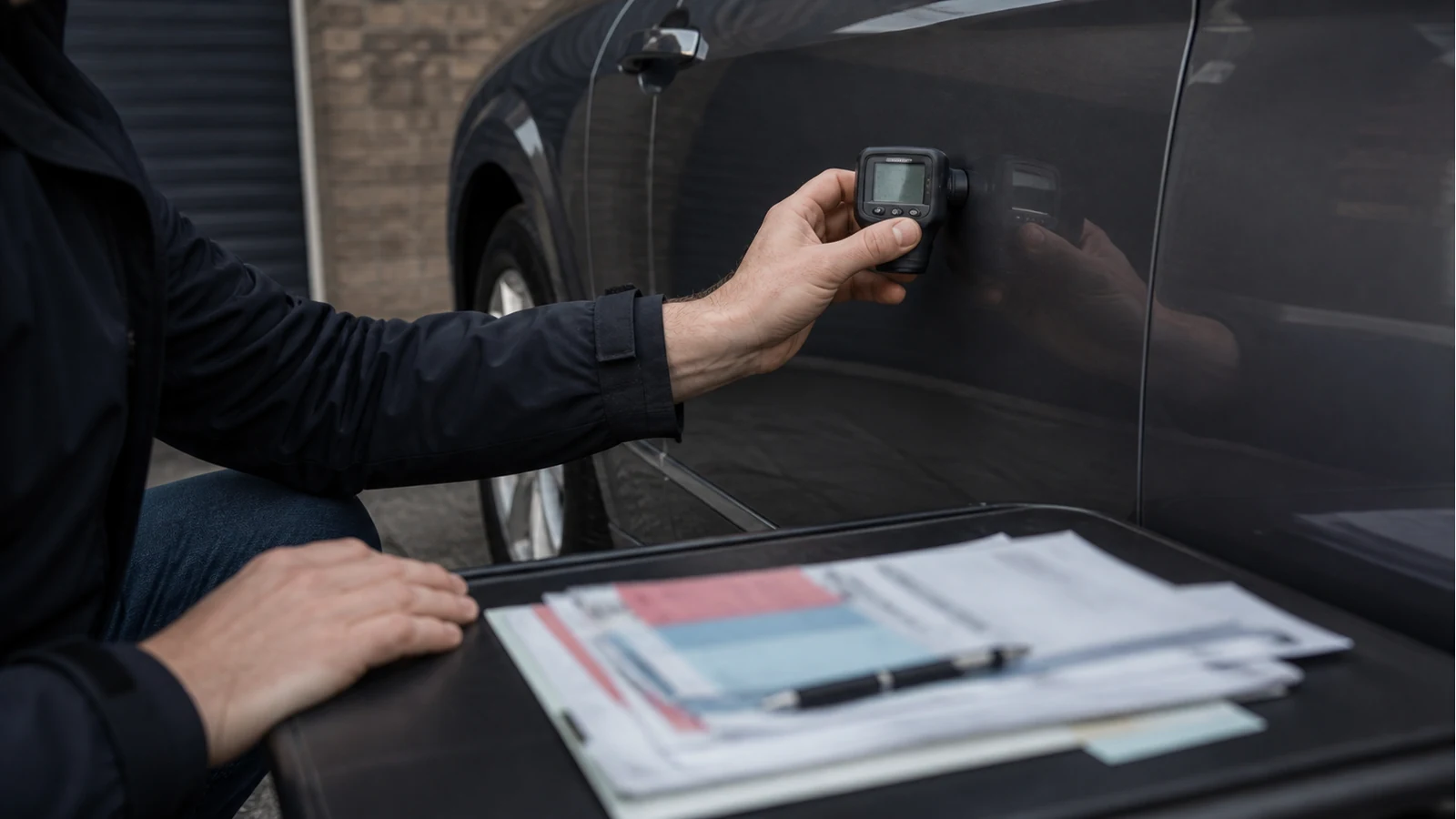
Readings help when a seller says "never damaged" but one quarter, door or wing is much thicker than comparable panels. The carVertical paint gauge guide explains why a thick layer can point toward repair or filler, while also warning that there is no single universal number. Use the gauge to decide what evidence to request: repair invoices, photos, history report, MOT trail and an inspection if the car is valuable or safety-critical.
Decision table for repaired-car buyers
| Situation | What paint readings mean | Next action |
|---|---|---|
| Seller openly declares Cat N cosmetic repair | Readings may help locate repainted panels. | Check history, invoices, MOT and repair quality before pricing. |
| Seller declares Cat S structural repair | Paint readings are secondary to structural repair evidence. | Follow the GOV.UK repaired write-off guide and consider an independent engineer. |
| No category disclosed but readings show a heavy cluster | Possible repair, filler or repaint; not proof of write-off. | Run a vehicle history check and ask direct questions. |
| Category status unclear and seller blocks checks | The risk is information failure. | Walk away or inspect professionally before any deposit. |
Cheaper repaired car: bargain or trap?
The RAC write-off category guide gives a consumer-friendly explanation of the categories and why some repaired cars can return to the road while others cannot. A repaired car can be a rational purchase if the category, repair quality, price, insurance implications and future resale are all understood. The trap is paying non-repaired-car money for a car whose repair history is hidden or poorly documented.
Negative fit and stop conditions
This article is not legal advice, insurance advice or an engineering inspection. Stop treating paint readings as enough when the car is Cat S, when airbags or structural areas may have been involved, when VIN or V5C details do not match, or when the seller avoids history checks. The official GOV.UK used vehicle check page is the baseline for paperwork and MOT checks.
How to use paint clues without confusing the category
Think of the category as a record question and the paint reading as a bodywork question. A car can be repainted without being Cat S or Cat N. A Cat N car may have cosmetic repairs that show clearly in the paint. A Cat S car may have structural repair quality that the gauge cannot judge at all. Keeping those questions separate prevents a common buyer error: seeing a high reading and assuming the legal history, or seeing normal readings and assuming the car has never had serious damage.
The correct sequence is simple. First, ask whether any category marker exists and run the appropriate history checks. Second, inspect the vehicle identity and MOT trail. Third, use paint readings to test the seller's story about bodywork. Fourth, decide whether the remaining uncertainty is acceptable at the price. If structural repair is involved, price alone should not settle the question. You need confidence in repair quality, roadworthiness and insurability.
For negotiation, avoid dramatic accusations. Say, "This quarter reads very differently from the other side and I can see repair clues. What work was done, and do you have invoices or photos?" A good seller can answer. A poor seller may deflect, rush you or change the story. The response is often more useful than the number. If the car is cheap because it is transparently repaired and documented, you can make a rational decision. If it is cheap but the explanation is missing, the discount may be payment for risk you do not understand.
When an engineer is worth the money
Escalate when the car is high value, family transport, structurally marked, recently repaired, or showing several red flags at once. A trained inspection can look beyond paint: chassis alignment clues, suspension mounting points, corrosion, braking, steering, warning lights and road-test behaviour. A paint gauge belongs in the first-screening toolkit. It should not be the final authority on a repaired car's safety.
A practical buyer can set three price bands. Full-market money requires clean history, matching paperwork and bodywork evidence that fits the advert. Discounted money may be fair for declared cosmetic repairs with invoices and tidy inspection results. Walk-away money applies when the seller wants full value while asking you to accept hidden or unexplained risk. Paint readings help place the car in one of those bands, but the category record and repair evidence decide whether the risk is acceptable.
When this check is not enough
Do not use a paint thickness gauge as a standalone proof of accident history, structural safety, legal status or formal calibration.
When to stop and get a professional inspection
Stop or escalate when paperwork does not match, category/history is unclear, readings are inconsistent with visible damage, the panel material is unsuitable, or the decision affects safety or a large payment.
Next step
If the immediate task is to spot panels that deserve more questions, a handheld gauge such as the PaintCoating paint coating thickness gauge can help. Use it before you negotiate, not after you have already decided to believe the advert.