Clear Coat Thickness Before Polishing UK
Direct answer: Clear Coat Thickness Before Polishing should be used as a decision aid, not as a verdict machine. A paint thickness gauge can make hidden repair clues visible, but the useful result is the pattern across comparable panels. In the UK, that pattern should be checked beside the vehicle's paperwork, MOT history, service evidence and the seller's explanation before money changes hands.
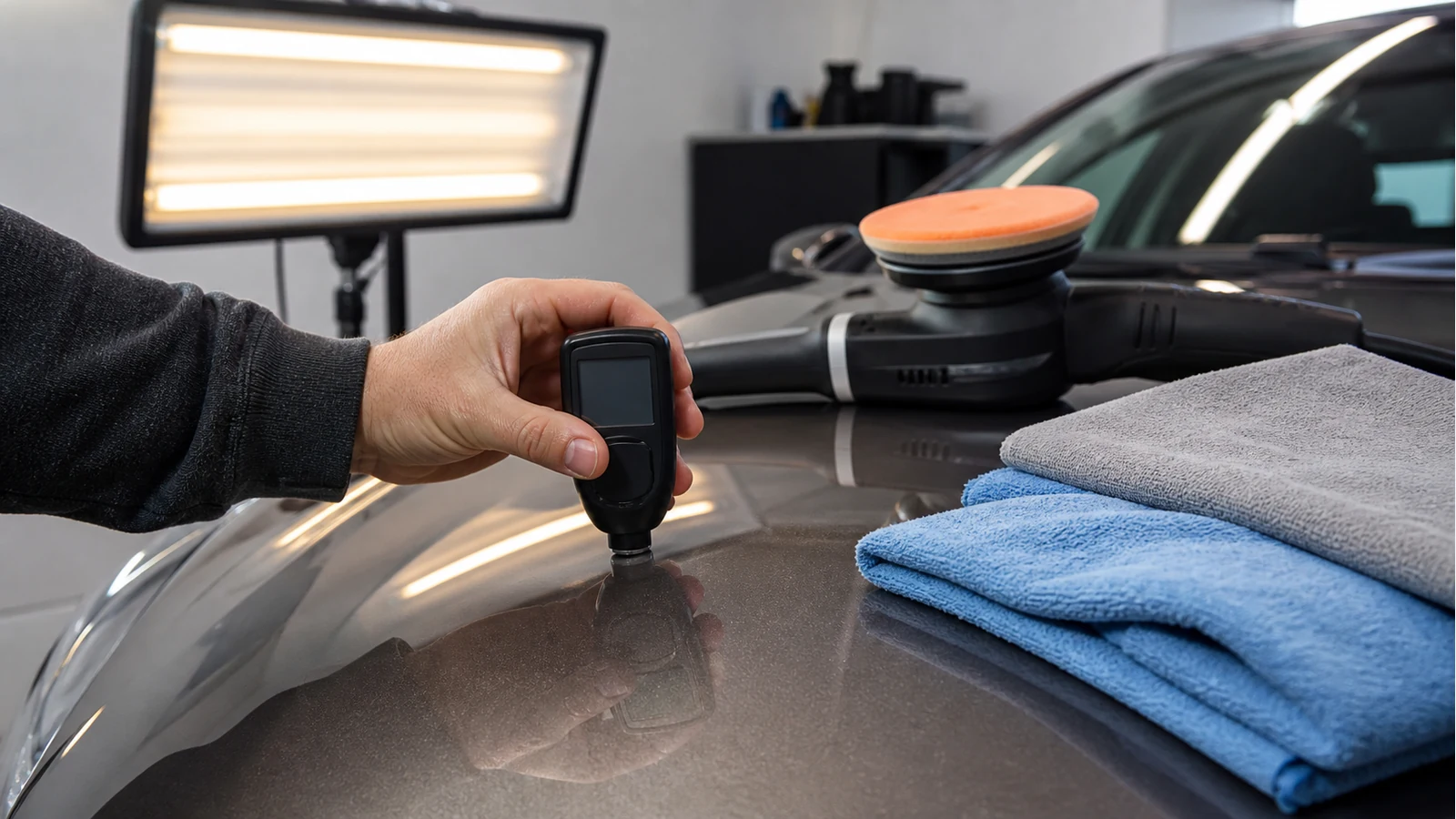
A gauge measures total coating, not clear coat alone
The first rule for detailers is modesty. A typical handheld automotive gauge measures the total non-destructive coating thickness over a compatible base, not the exact remaining clear coat. The ISO 2178 magnetic method covers non-magnetic coatings on magnetizable base metals, while ISO 2360 eddy-current method covers non-conductive coatings on non-magnetic conductive metals. Neither page turns a total reading into a guaranteed clear-coat number. For polishing, the reading is a risk signal.
Diagnostic ladder before machine polishing
- Level 1: visual inspection. Check edges, swage lines, previous strike-through, bird-lime etching, lacquer peel and repainted panels. If the paint is already failing, measurement is secondary.
- Level 2: baseline readings. Take several readings on broad, flat areas that appear original. The detailing guide from Car Detailing Planet recommends multiple readings per panel and using microns for precision.
- Level 3: compare risk zones. Edges, ridges and repainted sections deserve gentler assumptions. If a panel is much thinner than surrounding panels, reduce aggression.
- Level 4: test spot. Use the least aggressive pad and polish that improves the defect. Re-measure if the job is intensive or repeated.
- Level 5: customer conversation. Explain when correction is limited by paint risk, not by skill or effort.
How readings change your polishing choice
| Finding | Polishing response |
|---|---|
| Consistent readings and normal visual condition | Proceed with a normal test spot and conservative correction plan. |
| One panel much thinner than comparable panels | Use a milder approach, avoid heavy cutting, and document the limitation. |
| High readings suggesting repaint or filler | Expect different paint behaviour; test gently and avoid assuming factory hardness. |
| Failing lacquer, exposed primer, heat damage or edge burn | Stop polishing that area and recommend repaint or specialist repair advice. |
The carVertical guide is aimed at used-car buyers, but its warning against blindly following a universal number is useful for detailers too. A car's history, model, panel material and previous repair can all change the meaning of a reading.
Negative fit and stop conditions
Do not sell a heavy correction package because the gauge shows a comforting total number. Do not claim you have measured clear coat exactly unless you have equipment and method that actually isolates it. Stop when readings are erratic, when the panel is plastic and outside the gauge's capability, when the customer wants defect removal that would require unsafe material removal, or when paint failure is already visible.
How to explain the limit to a customer
The clearest customer explanation is: "This tool tells me the total coating thickness on compatible panels. It helps me spot low or unusual areas before I choose how aggressive to be. It does not tell me exactly how much clear coat is left." That sentence protects both sides. The customer understands why you may refuse a heavy correction, and you avoid promising a level of certainty the tool cannot deliver.
For a practical job sheet, record the panel, three readings, visual condition and chosen approach. For example: bonnet consistent and healthy-looking, light one-step polish; nearside wing lower than surrounding panels, avoid heavy cutting; rear quarter unusually high, treat as possible repaint and test gently. This style of note is more useful than a single average because polishing risk is local. Edges, body lines and previous repairs are where mistakes often happen.
The safest alternative to heavy correction is often expectation management: improve gloss, reduce obvious haze, leave deeper defects, and protect the finish. A detailer who can explain why "less correction" is the professional choice builds more trust than one who chases every mark. If the paint is thin, failing, blistering, peeling or already struck through, the correct next step may be a bodyshop conversation rather than another pass with a machine polisher.
Proceeding without padding the risk
When readings look comfortable, still start with a test spot. Use good lighting, clean pads, controlled machine speed and short inspection cycles. Re-check vulnerable areas if the correction escalates. When readings look uncertain, reduce the cut before you reduce the price. The reader's real decision is not "can I polish this car?" but "what level of improvement is honest for this paint?" A gauge helps answer that better question.
Build a ladder of service options before the customer arrives: enhancement detail, one-step correction, targeted correction, or no polishing on risky areas. Then the reading informs an existing decision rather than forcing you to improvise under pressure. If the bonnet is healthy but a repainted wing is uncertain, you can polish the bonnet normally and protect the wing with a safer process. If several panels look thin or unstable, offer cleaning, decontamination and protection instead of correction. That is still a professional result because it respects the material in front of you and leaves a clear record for the customer.
When this check is not enough
Do not use a paint thickness gauge as a standalone proof of accident history, structural safety, legal status or formal calibration.
When to stop and get a professional inspection
Stop or escalate when paperwork does not match, category/history is unclear, readings are inconsistent with visible damage, the panel material is unsuitable, or the decision affects safety or a large payment.
Next step
For mobile or part-time detailers who need a quick risk check before choosing a pad and compound, the PaintCoating paint coating thickness gauge can support the pre-polish conversation on compatible metal panels. The useful promise is caution and consistency, not certainty about every micron of clear coat.