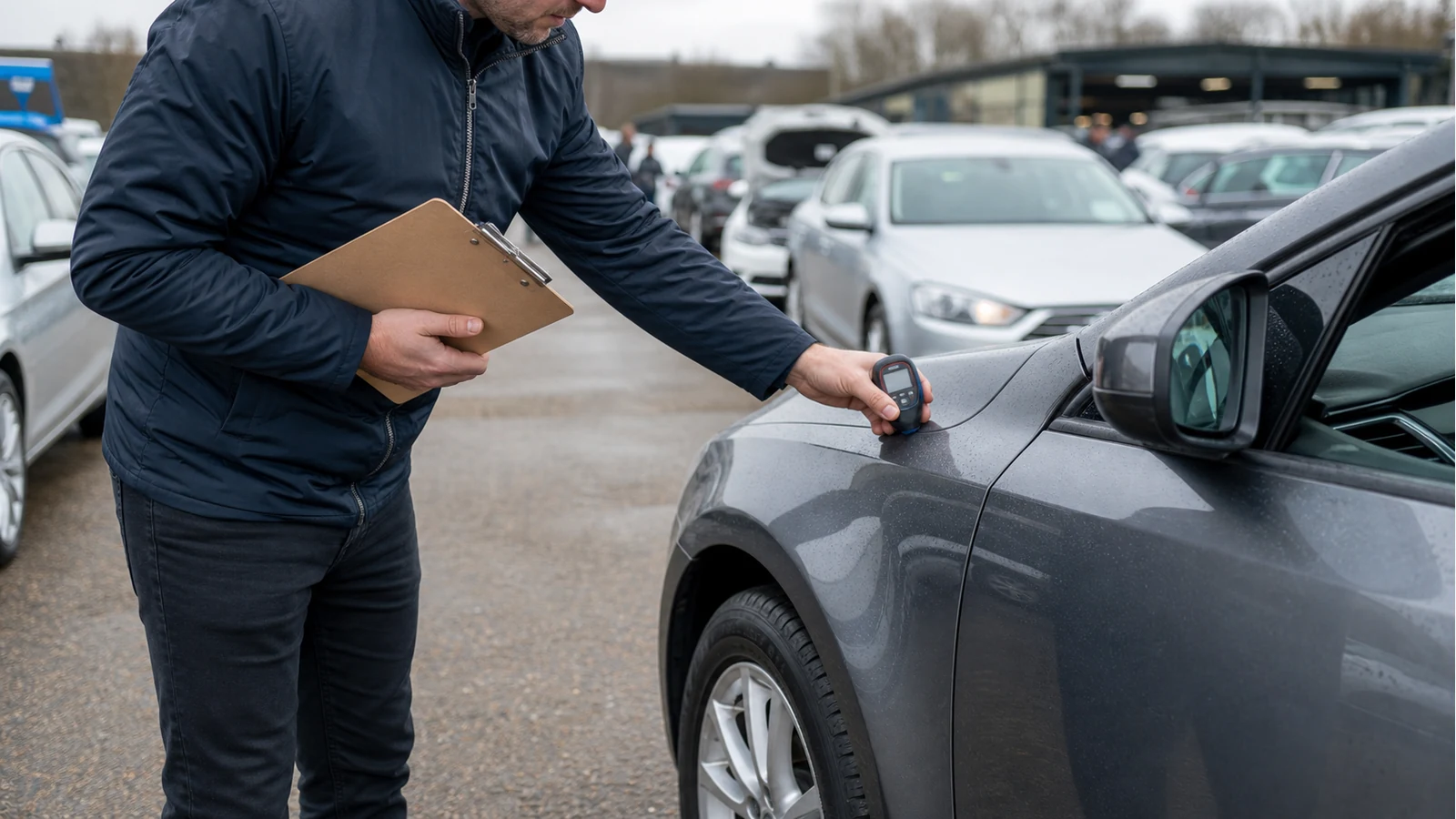
Paint Depth Gauge Car Auction Checklist UK
Direct answer: Paint Depth Gauge Car Auction Checklist UK should be used as a decision aid, not as a verdict machine. A paint thickness gauge can make hidden repair clues visible, but the useful result is the pattern across comparable panels. In the UK, that pattern should be checked beside the vehicle's paperwork, MOT history, service evidence and the seller's explanation before money changes hands.
The auction problem is speed, not curiosity
At auction you are rarely doing a perfect inspection. You are trying to avoid bidding strongly on a car that deserves caution. UK paint-test suppliers describe gauges as quick, non-destructive tools for dealers, auction buyers and bodyshops; DFT Instruments' paint thickness guide frames them as a way to spot resprays, filler and inconsistency that the eye can miss. That does not make the reading a complete condition report. It gives you a triage signal.
Three-minute auction routine
- Check the catalogue details and visible identity first. If the story is already weak, save your time.
- Walk the car once for obvious mismatch, fresh paint smell, ripples, uneven gaps and masking marks.
- Take a baseline from a likely original upper panel, then measure each metal corner and both sides.
- Mark the car mentally as green, amber or red. Green means no obvious paint concern; amber means bid lower; red means skip unless you can inspect properly.
- Before bidding, remember that GOV.UK used vehicle buying checks still recommends vehicle-history, MOT, recall and log-book checks. The gauge cannot do those for you.
Fast decision table
| Lane finding | Likely auction action |
|---|---|
| Consistent metal-panel readings and tidy gaps | Keep inspecting mechanical and paperwork risk; do not raise the bid just because paint looks clean. |
| One side higher than the other with a plausible repair note | Set a lower ceiling and price in paint/body uncertainty. |
| Very high local cluster, filler suspicion or poor inner-edge finish | Skip unless margin is large and post-sale inspection terms protect you. |
| Any sign of write-off history you cannot verify | Use the official GOV.UK repaired write-off guide logic: check history and consider an expert inspection. |
Trade-offs in a busy yard
Speed creates false confidence. One reading near a wheel arch can be affected by shape, dirt, probe angle or previous smart repair. The cure is not to spend twenty minutes on every car; it is to repeat a small number of comparable readings. The AA inspection checklist shows why body checks belong inside a broader inspection. If tyres are poor, warnings are on, paperwork is missing and paint readings are odd, the combined signal matters more than any one data point.
Negative fit and stop conditions
This workflow is not right for formal valuation, insurance assessment or structural sign-off. Stop using the gauge as your main decision tool when the auction terms prevent sensible checking, when the car is wet or dirty enough to make readings unreliable, or when the category/history status is unclear. In those cases, the best auction discipline is to lower the bid sharply or leave the lot alone.
How to turn readings into a bid ceiling
The auction version of this task is less about proving exactly what happened and more about pricing uncertainty. A clean pattern does not make a car perfect; it only removes one common bodywork concern. An amber pattern should reduce your bid ceiling because you may need paint, panel alignment work, further history checks or retail disclosure. A red pattern should make you ask whether the margin is still attractive after transport, inspection, repair, customer negotiation and the chance that the car is harder to retail.
A simple lane note can be enough: "left rear high, bumper fit poor, no invoice seen" or "front wing high but gaps tidy, check history before retail". These plain-English notes are more useful than a list of numbers you cannot interpret later. If you buy for resale, the note also helps you talk honestly to your own customer or workshop. The point is not to win every lot. It is to avoid letting auction pace push you into treating uncertainty as profit.
Do not fight the environment. Wet panels, dirty lower doors, crowded viewing lanes and time pressure all reduce confidence. In those conditions, take fewer but better readings on clean accessible metal, then price the risk. If you cannot get enough evidence, your conservative option is a lower bid or no bid. That discipline is especially important for side-hustle buyers because one hidden repair can consume the margin from several successful flips.
When this check is not enough
Do not use a paint thickness gauge as a standalone proof of accident history, structural safety, legal status or formal calibration.
When to stop and get a professional inspection
Stop or escalate when paperwork does not match, category/history is unclear, readings are inconsistent with visible damage, the panel material is unsuitable, or the decision affects safety or a large payment.
Next step
When your auction routine depends on quick metal-panel comparisons, the PaintCoating paint coating thickness gauge is a relevant tool to keep in the glovebox. It should support a bid ceiling, not justify ignoring paperwork, history or roadworthiness risk.